Why Does It Cost 5–6% to Sell a Home in Florida?
For decades, most homeowners in the United States have been told that selling a home typically costs 5–6% of the sale price in real estate commission. On an $800,000 home, that can equal $40,000–$48,000, which naturally leads many homeowners to ask:
“Why does it cost that much to sell a home?”
The answer largely comes from how the real estate industry evolved over time. Understanding that history helps explain why commissions look the way they do today.
The Traditional Commission Model
In a traditional home sale, the commission is typically split between two agents:
-
The listing agent, who represents the seller
-
The buyer’s agent, who represents the buyer
The total commission—often between 5–6%—is usually divided between those two sides of the transaction.
From there, each agent typically shares their portion with their brokerage.The example below shows how a typical real estate commission in Florida can look on an $800,000 home.
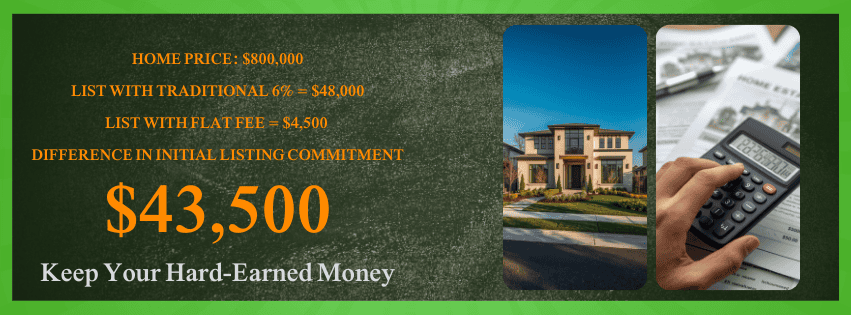
In the traditional model, both Realtors would split $48,000...
Why the Percentage Model Became Standard
The commission structure developed decades ago when selling a home involved significantly more manual work. Before the internet, agents were responsible for:
-
Printing property listings and maintaining brokerage listing binders
-
Physically distributing listing books to offices
-
Coordinating showings through phone calls and office staff
-
Managing paper contracts and in-person negotiations
-
Marketing homes through newspaper advertising and direct mail
Because selling homes required significant time, coordination, and marketing expense, the percentage model became a practical way to compensate agents for the work involved.
Over time, the structure became widely adopted across the industry and eventually became the model most consumers were familiar with.
The Role of Cooperation Between Agents
Another reason commissions developed this way is cooperation between agents.
When a home is listed, the listing brokerage typically offers a portion of the commission to any agent who brings a buyer. This creates an incentive for buyer agents across the market to show the property to their clients.
This cooperative structure helped create the Multiple Listing Service (MLS), where brokerages share property listings and work together to facilitate transactions.
Technology Has Changed the Process
In the last 20 years, the home selling process has changed dramatically.
Online listing platforms, digital marketing, electronic contracts, and automated systems have streamlined many parts of the transaction that once required much more manual coordination.
Because of these efficiencies, many sellers today are exploring alternative fee structures, including:
-
flat-fee brokerages
-
limited-service listings
-
hybrid pricing models
These approaches aim to provide professional representation while reducing the overall cost structure for homeowners.
However, because the traditional model has been so widely used for decades, many consumers are simply unaware that other options exist.
Are Commissions Negotiable?
Yes.
Real estate commissions are always negotiable, and sellers are free to choose the pricing structure that makes the most sense for their situation.
Markets change over time, and today's housing market often requires sellers to be thoughtful about every aspect of their transaction—including how their property is represented and what they pay for that representation.
In traditional commission structures, the compensation offered to both the listing agent and the buyer’s agent is often discussed together at the time the home is listed. Some newer models separate those decisions so sellers can evaluate each component individually depending on the circumstances of the offer and the transaction.
The most important factor is choosing a brokerage that provides the level of service and expertise you are comfortable with and that is genuinely focused on protecting your interests throughout the process.
A Different Approach
At Gulf Coast Flat Fee Real Estate, our model is built around a simple idea:
The quality of service shouldn't change based on price.
Instead of charging a percentage of the sale price, we operate on a flat fee model designed to provide full professional representation with transparent pricing.
Under this approach, the seller agrees to our compensation when the home is listed. If another agent brings a buyer to the transaction, the terms offered in that particular offer—including any compensation offered to that agent—can be evaluated as part of the overall negotiation.
We believe that when sellers understand how the process works, they are better equipped to evaluate offers and make decisions that align with their goals.
Want to see how our flat fee model works?
The Bottom Line
The traditional commission model exists because of how the industry developed historically. It worked well for decades when selling a home required significant manual marketing and coordination.
Today, technology and new brokerage models have created more options for homeowners.
Understanding how these structures work allows sellers to make informed decisions about how they want their home represented and what they want to pay for that service.
If you're considering selling a home in Sarasota, Lakewood Ranch, or Manatee County, understanding your options is an important first step. Every home and every seller’s situation is different, and the right strategy always begins with clear information.
Wonder what sellers typically save? You can use our savings calculator here